Wanted Persons can be found through the county’s online portal, where the searchable database shows the wanted persons list and individual records. By entering a name or alias you run a wanted person lookup by name, see photos, age, height and any active warrants. It also shows how to search for a wanted person online and lets you verify whether a suspect is active, check the status of an outstanding warrant, and learn why the person appears on the list.
Law enforcement agencies encourage anyone who spots a listed individual to submit an anonymous tip through the portal or by calling the department line, and shows how to check if someone is wanted. When you report, provide the name, last known address, physical description and any sightings. This helps verify the wanted person information and can speed capture of an active wanted person. The database notes when a wanted individual is apprehended or removed, keeping the public wanted list current.
How to Search Wanted Persons
Wanted Persons searches begin with an official county or agency page, not a private people-search site. The process can narrow a name to a photograph, aliases, physical description, case number, issuing court, and current agency status. To explore further official documentation and county records, you can consult jail mugshots online registry. A public listing serves as an operational notice, not proof that every allegation has been decided. Confirm the source and status before acting on a possible match.
Official Search Portal: https://www.douglascounty-ne.gov/
Steps to Search
- Open the county portal at the address above and locate the site’s main navigation or search field. The supplied address is the county’s main portal; it does not by itself prove that the first screen contains wanted-person results. Use visible agency links or the portal’s search function rather than a link sent by an unverified person.
- Locate a page owned by Douglas County or another government body connected to the case. Search using terms such as “wanted,” “warrants,” “sheriff’s office,” “law enforcement,” or “public records” if those labels appear in the portal. If no public list appears, use the office contact shown at the end to confirm which agency publishes the record.
- Search one complete name at a time. Start with the full legal name shown on the notice, then run a separate search for a known alias. Repeat the search with spelling variations only when the record supplies them. A common name can create unrelated results, so never choose a listing from the name alone.
- Open each plausible result and compare its identifying details with the person you are checking. Review the photograph, aliases, date of birth, height, weight, scars, tattoos, or other listed characteristics. Treat an older photograph as a dated clue rather than a prediction of the person’s current appearance.
What Makes a Wanted Person Match Reliable?
A reliable match depends on several details that belong to the same record. The table below explains the fields that deserve attention during a wanted person search by name.
| Record field | What to compare | Reason for the check |
|---|---|---|
| Name and aliases | Full legal name, former names, suffixes, and spelling changes | Aliases can connect separate court entries to the same person. |
| Photograph and marks | Photo, scars, tattoos, eye color, hair color, and other visible details | Several traits reduce the chance of matching the wrong person. |
| Age and build | Date of birth, height, weight, and general body build | These fields support or contradict a possible match. |
| Case identifiers | Case number, warrant number, citation, or court reference | The number ties the notice to a specific legal record. |
| Agency and court | Issuing law enforcement agency, supervising agency, and court | The named source controls case-specific verification. |
| Legal basis | Arrest warrant, failure to appear, probation or parole issue, or custody matter | The category explains why the agency lists the person. |
| Last known place | City, county, state, date, and circumstances of the last reported sighting | The location can be outdated, so it requires agency confirmation. |
| Date and status | Posted date, last reviewed date, active status, capture notice, or removal notice | The date shows how current the publisher’s entry appears to be. |
A photograph by itself is a weak match, and a common name offers even less. A strong result aligns the identifying details, case source, and agency status. If one critical field conflicts, pause and ask the issuer before reporting a sighting.
Classifications and Reasons for Wanted Listings
A wanted listing can arise from an arrest warrant, a failure-to-appear process, or a violation connected to probation, parole, or custody. The label “wanted” by itself does not identify the legal basis. Read the case number, court, agency, offense description, and status fields before drawing a conclusion about the person or case.
| Listing basis | Typical legal reason | Fields to compare | Point requiring confirmation |
|---|---|---|---|
| Arrest warrant | A court-authorized warrant supports an agency request for custody | Warrant number, court, case number, bond, service status, and agency | The warrant’s current status and location |
| Failure to appear | A person did not appear as required or faces a related court process | Court date, case number, warrant or order, and issuing court | Whether the court still lists the matter as active |
| Supervision or custody violation | An alleged violation, missed report, unauthorized move, or other order-related issue | Supervising agency, case number, violation type, and warrant status | Whether the entry concerns a violation or a separate criminal case |
One person can have more than one entry from a court, sheriff’s office, police department, probation agency, or parole authority. Each source may publish a different part of the legal picture. A search of one county system cannot confirm the status of every case connected to that person.
Active Arrest Warrants and Criminal Allegations
An active arrest-warrant listing connects a named person to a warrant and the court or agency handling it. The public notice may show only a photograph and basic description, or it may include a case number, alleged offense, bond amount, and service status. A warrant listing does not tell you whether the person was convicted, acquitted, or later resolved by another court order.
- Compare the legal name, aliases, and identifying description with the warrant notice.
- Record the warrant or case number exactly as displayed, including any court prefix.
- Identify the issuing court and agency so later questions reach the correct office.
- Read bond or service conditions only when the source states them; never assume missing terms.
- Check the listing date and status before treating the warrant as active.
A Douglas County result speaks only to the entry shown by that source. Another jurisdiction could hold a separate warrant based on a different case or violation. Exact-name clearance in one court system does not clear the same name from county, state, or federal records. The agency named in the notice must confirm its own case status.
Probation, Parole, and Custody Violations
Probation, parole, and custody listings connect a person to a supervision order or a related violation process. Possible issues include a missed report, an unauthorized move, failure to meet a condition, or another matter defined by the supervising authority. The public page may name the agency and violation category without exposing every underlying detail.
- Identify the probation or parole agency named in the record.
- Separate the supervision case from any new criminal case listed nearby.
- Check whether the entry cites a warrant, detainer, violation report, or court order.
- Review dates tied to reports, hearings, or custody status rather than relying on the original sentence date.
- Confirm the current status with the agency shown on the listing.
A supervision violation is not the same as a new criminal charge. The original case may remain connected to the public entry even after a new allegation appears. Some supporting records may be withheld because the matter is sealed, confidential, or under active agency review.
Reporting Information and Safety Procedures
Report a possible sighting to the agency connected to the official notice. The Douglas County Clerk / Public Records office can explain county record procedures, but an active warrant requires confirmation from the issuing agency or court. Keep exact facts separate from rumors, and never confront a listed person. A safe report gives trained personnel time to verify identity, jurisdiction, and current case status.
Submitting Anonymous Lead Information to Law Enforcement
An anonymous report is anonymous only when an official channel states that it does not collect identifying details. The county portal address supplied for this page does not confirm an anonymous submission service, a lead form, or two-way contact. Read the form and its privacy terms before sending personal details through any agency page.
- Prepare the known facts before opening a form so the account stays clear and factual.
- Mark each statement as something you observed, something another person said, or something you concluded.
- Remove gossip, accusations, and claims that lack a source.
- Use only an official agency channel connected to the case.
- Save any confirmation number, receipt, or timestamp supplied by the agency.
A portal address alone does not promise confidentiality, encryption, or anonymity. If those protections matter to the reporter, ask the agency what data it collects and how it assigns a reference number. Never send documents through an email address or messaging account that appeared only in an unverified wanted-person post.
Essential Details to Provide in a Lead Report
A useful report separates ten categories of data. The table below shows a clear format for each category so agency staff can compare the sighting with the source record.
| Category | Useful format |
|---|---|
| Name or alias | Provide every name known from the source notice and label each as observed or reported. |
| Date and time | Give the exact date, approximate clock time, and how the time was determined. |
| Place | Name the nearest street intersection, business, landmark, address, or mile marker that you observed. |
| Physical description | Record height, build, hair, eyes, scars, tattoos, clothing, footwear, and visible aids. |
| Observed items | List only items you saw, such as a backpack, phone, cane, or bag; do not guess their contents. |
| Vehicle | Provide the color, make, model, body style, plate number, and direction of travel if safe to do so. |
| Activity | Describe walking, driving, waiting, entering, leaving, or following the person’s normal movement. |
| Source of knowledge | State whether you saw the person directly or received the sighting from another person. |
| Case reference | Include the warrant, citation, case number, and issuing agency shown on the official listing. |
| Reporter contact | Use only the contact method requested by the agency and state when and where a callback is safe. |
Separate observed facts from deductions in the report. An exact intersection, direction of travel, vehicle plate, and precise time often help an agency check public records without adding unsupported claims. Never enter private property, touch an abandoned item, or take another risk merely to collect more details.
Safety Protocol for Law Enforcement Contact
Do not approach, follow, confront, or restrain a listed person. Civilians should not perform a citizen’s arrest or attempt to decide whether a warrant is valid in person. Your role is to report facts from a safe place and let law enforcement verify the legal authority.
- Maintain distance and keep a clear route away from the person.
- Avoid touching the person, entering a vehicle, or entering a property.
- Remain out of traffic and away from doors, windows, weapons, or animals.
- Refrain from blocking a walkway, vehicle, or possible exit route.
- Retreat to a secure public place if the person notices you or reacts aggressively.
- Contact the agency named in the notice and state your location and safety.
Call local emergency services if a crime is occurring now, someone is threatened, or immediate danger is present. Do not wait for a portal update during an active emergency. For a past or non-emergency sighting, use the official agency reporting channel and avoid sharing the last known address or other private locations.
Reporting a Sighting in Another Jurisdiction
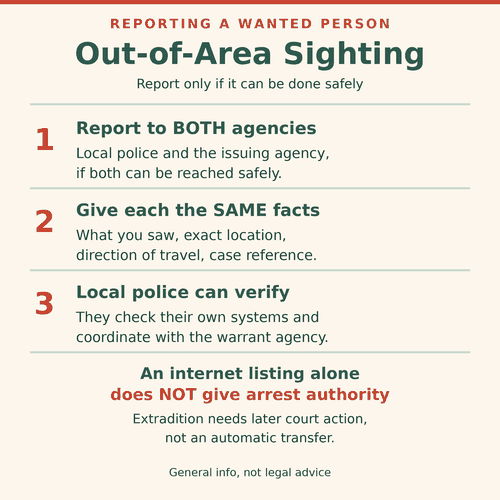
Report an out-of-area sighting to local police and the issuing agency if both can be reached safely. Give each agency the same observed facts, exact location, direction of travel, and case reference. Local officers can check their own systems and coordinate with the agency holding the warrant. An internet listing alone does not give a local officer the authority to arrest, and extradition involves later court action rather than an automatic transfer after a sighting.
Record Accuracy and Resolution
A public wanted list is a distributed record, not a permanent judgment. An agency updates its own entry, while a court docket, sheriff’s record, and county webpage operate as separate systems. One source can change before another. The supplied county details give no promise of real-time service, so an age or status check belongs on the same record before you report a sighting or assume it is resolved.
Delays in Updating Captured or Located Status
Capture, location, and removal are separate events. A report that someone was seen does not always mean the person entered custody. An arrest can occur without an immediate public update, and a case can continue after custody. Status labels also vary among agencies, so readers should use the publisher’s exact wording.
| Status label | Meaning that may be attached to it | Verification action |
|---|---|---|
| Active | The publishing agency currently lists the person for apprehension | Check the date and confirm the warrant status with the issuer. |
| Located | A sighting or location report has been received | Ask whether the subject entered custody or remains free. |
| Captured or apprehended | An agency has reported that the person entered custody | Verify the arrest date, agency, and current case condition. |
| Removed | The publisher no longer carries the listing on that public page | Ask whether the warrant was cleared, served, or transferred. |
The date of an arrest and the date a webpage removes an entry are different facts. Several agencies can hold separate warrants, so resolving one case does not clear every other entry. Return to the source agency rather than relying on an old photograph or a copied social-media post after a reported capture.
Processing Time for Recently Added Listings
The supplied official details provide no posting interval, system service target, or record-processing time for newly added wanted listings. Any claim that the county updates every hour, day, or other fixed period would lack support from the supplied source. A date shown on a record may describe posting, review, capture, or another event, so read the label attached to that date.
- Check the record for a posted date, status date, and last-reviewed label.
- Confirm that the date refers to this case rather than an older arrest or court event.
- Compare the entry with the issuing agency’s page or court case when the dates conflict.
- Prepare a correction packet before contacting the publisher.
- Submit the exact URL, quoted field, conflicting source, and date checked through an official channel.
- Keep the agency’s receipt or reference number for later follow-up.
A recently added listing deserves a closer source check because an identity detail or status label may still be under review. Do not edit a screenshot, remove text from its original context, or publish sensitive case data to force a correction. You can also cross-reference these official findings by accessing verified recent arrests index online. Report the discrepancy plainly and let the agency compare its records.
Sealed, Confidential, and Restricted Agency Records
A public wanted notice and its supporting case file are different records. A public-facing page may show a name, photograph, alleged offense, and agency, while affidavits, victim details, tip materials, or portions of a court file remain restricted. Sealing can result from a court order, privacy protection, an active investigation, or a statutory rule that applies to the specific material.
| Record layer | Public treatment | Proper source |
|---|---|---|
| Public wanted notice | May display basic identity, case, and status fields chosen by the publisher | Publishing sheriff, police agency, or other named issuer |
| Court docket | May list public filings, appearances, orders, and case status | Issuing court or its clerk |
| Supporting affidavit or case file | May contain sealed or restricted pages even when the case appears publicly | Court and case number shown in the notice |
| Confidential lead material | Stays outside public records because of its purpose or handling rules | Agency that received the lead |
| Protected personal details | May be withheld to protect a victim, witness, minor, or other protected party | Issuing agency or court |
A missing photograph, alias, address, or case detail does not prove that the record is complete or that the person has been cleared. A county clerk cannot release sealed material or replace the agency that controls an active warrant. Ask the agency to identify the case and current status, ask the court about sealed filings, or use the county office to confirm its own records process.
Contact Details
Use the following office details for questions about Douglas County public records or the county website. The phone number is the office line supplied for this page, not a confirmed arrest-warrant line, anonymous reporting service, or emergency line. For active warrant status, the agency named in the notice remains the proper source.
| Contact item | Supplied detail |
|---|---|
| Office | Douglas County Clerk / Public Records |
| Address | 1819 Farnam St, Omaha, NE 68183 |
| Phone | (402) 444-6000 |
| Office hours | Monday–Friday: 8:00 AM–4:30 PM |
| Official portal | https://www.douglascounty-ne.gov/ |
The supplied details list no email address, fee, lead form, record-processing time, or direct warrant lookup line. Confirm those items during office hours rather than assuming a private page provides them.
Frequently Asked Questions
Wanted persons services let citizens check if a name appears on an active law enforcement list. The portal supplies photos, descriptions, and case details. It helps families stay safe and supports investigations by providing accurate, public data. Use the official Douglas County site to get current information and learn how to report tips.
How can I search for a wanted person by name in Douglas County?
First, open the Douglas County wanted persons portal at the official website. Next, enter the full name or known alias in the search box. Then, click Search to see any matching records. The result page shows photograph, age, last known address, and warrant status. If a match appears, note the issuing agency and call (402) 444-6000 for verification. Finally, do not approach the individual; let law enforcement handle the case.
What information is listed for each wanted person on the public record?
Each entry lists the wanted person’s name, photograph, and birth date. Next, it provides height, weight, and any distinguishing marks. Then, it shows known aliases and the offense that triggered the warrant. Also, the record displays the case number, issuing court, and current status of the warrant. Finally, a contact phone for the responsible law enforcement agency appears at the bottom.
How often are wanted persons records updated in Douglas County?
The county updates wanted persons records daily at midnight. First, new arrest warrants are added as soon as the court issues them. Next, any change in status, such as capture or dismissal, is posted within 24 hours. Then, the online portal refreshes the list automatically, so visitors always see the latest data. Finally, if you notice a discrepancy, call the clerk’s office to request correction.
Where can I report tips about a wanted individual in Omaha, NE?
Tips can be submitted to the Douglas County Clerk’s Office by phone. Call (402) 444-6000 between 8:00 AM and 4:30 PM, Monday through Friday. Next, you may use the online tip form linked on the official wanted persons page. Also, the office accepts anonymous written tips mailed to the address on file. Finally, always include the suspect’s name, description, and last known location for quickest response.
What should I do if I recognize a wanted person in my community?
Do not confront the individual under any circumstances. First, note the person’s appearance and any nearby landmarks. Next, call (402) 444-6000 and inform the dispatcher that you have a possible sighting. Then, stay at a safe distance while providing the officer with exact location and direction of travel. Finally, follow any instructions given by law enforcement and avoid sharing the information publicly.